
The Romani Flag: Wheel, Sky, and Earth
In an increasingly globalized world, flags serve as powerful emblems of shared identity, history, and collective aspiration. For the Romani people—a complex tapestry of communities spread across every continent—the need for a single, unifying symbol became paramount in the 20th century. That symbol is the official Romani Flag: a striking design of blue, green, and red that encapsulates the heart of the Romani experience.
This flag is not the banner of a specific nation-state; rather, it represents the heart and history of a global people.
(Suggested Image Placement 1: A close-up or clear graphic of the official Romani Flag, displaying its blue, green, and red elements distinctly.)
The Historic Congress of 1971
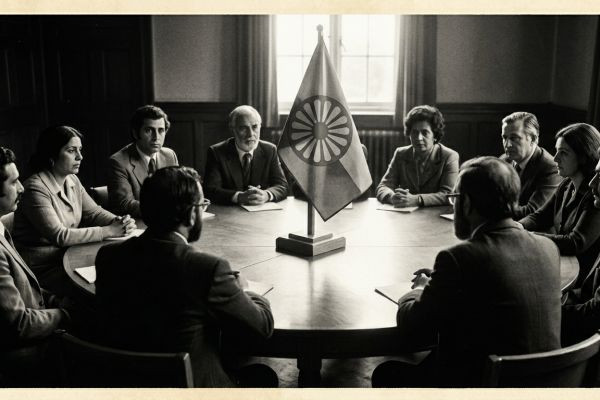
While individual Romani groups had used various banners locally for years, the unified flag we recognize today was formally adopted during the First World Romani Congress. This historic gathering took place near London, UK, in April 1971.
The congress was a milestone for Romani activism. Leaders from many countries came together to discuss language standardization, civil rights, and, crucially, international representation. Adopting the flag—which was based on an earlier 1930s design by the General Union of the Roma of Romania—was one of the congress’s most important and visible achievements. It provided an internationally recognized symbol under which Roma, Sinti, Romanichal, and other groups could unite their diverse voices.
(Suggested Image Placement 2: A vintage or documentary-style photo evoking the landmark gathering. Visual reference connection to Image 2 could be made by referencing the light quality/parchment tone used in previous images, if the user wanted a cohesive 'aged' aesthetic, but a standard historical photo is also fine here.)
Decoding the Design: What the Elements Mean
The beauty of the Romani flag lies in its simplicity and profound depth of meaning. The flag consists of three distinct components:
1. The Blue Field (Top Half) The vibrant blue stripe that makes up the top half of the flag symbolizes the vast, open sky. This is not just a reference to nature; it represents the idea of freedom and the heavens. It also signifies the spiritual values that bind the Romani people, a reminder that they are united under one sky, regardless of the borders that might divide them.
2. The Green Field (Bottom Half) The rich green stripe across the bottom half represents the earth. It symbolizes nature, the land, and the fertile ground that has nourished the Romani people throughout their history. It evokes images of the natural world through which they traveled and settled, a visual tether to the reality of their earthly existence and their traditional closeness to the land.
3. The Red Chakra (The Center Wheel) This is arguably the most recognizable and loaded symbol within the design. The red, 16-spoked wheel in the center is known as the chakra (or roto). Its red color represents the blood spilled during the persecution and suffering of the Romani people, particularly commemorating the Phrajimos (Romani Genocide) during the Holocaust.
The wheel itself is the primary symbol of movement. It serves as a visual acknowledgment of the "thousand-year journey" and migration history (which we covered in Article 1). Furthermore, the 16-spoked design honors the Romani connection to their ancestral home; it deliberately mirrors the Ashoka Chakra found on the flag of India, symbolizing their cultural origins.
(Suggested Image Placement 3: A detailed close-up shot focusing specifically on the red chakra (wheel) at the flag's center, perhaps overlaid slightly on a traditional wagon wheel to emphasize the connection.)
A Symbol of Modern Pride
The adoption of the flag marked a new era. Today, it is flown proudly every April 8th (International Roma Day) at rallies, community centers, and official institutions worldwide. It is no longer just a symbol of past suffering, but an emblem of resilience, survival, and a flourishing, diverse, modern cultural identity.
By understanding the flag’s design, we gain a deeper appreciation for the complex interplay of history, nature, and the enduring quest for freedom that defines the Romani spirit.



 English
 Dutch
Dutch French
 German
 Russian
 Spanish
 Turkish
 Croatian
 Italian
 Swedish
 Danish
 Greek
Greek Albanian
 Romanian
 Bulgarian