
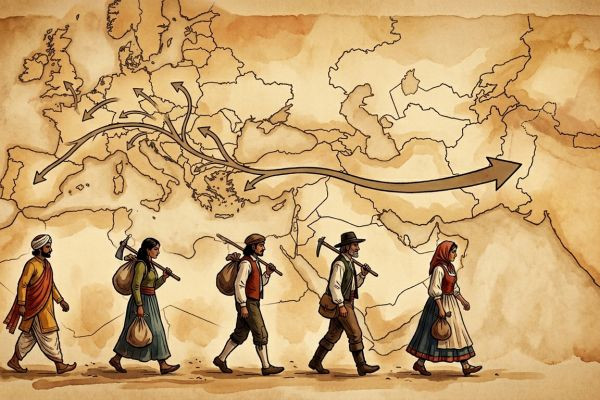
For centuries, the origins of the Romani people were shrouded in mystery, leading to numerous myths and misunderstandings. In Europe, they were often mistakenly called "Egyptians", the root of the word "Gypsy", because of their dark complexions and perceived exoticism. However, the last few decades of dedicated scholarship, combining historical linguistics and modern DNA analysis, have finally unlocked the true story of their exodus.
The Romani journey is an epic of resilience and adaptation, beginning not in Egypt, but in Northern India, over one thousand years ago.
The Initial Departure (c. 1000 CE)
The migration was not a single, sudden event, but rather a series of movements. Around the 10th or 11th century CE, ancestors of the Romani people left regions corresponding to modern-day Punjab, Rajasthan, and perhaps Kashmir. The reasons for their departure remain debated by historians, though theories include escaping the invasions of Mahmud of Ghazni, seeking new trade routes, or upheaval related to military conflicts.
Crucially, these ancestors were likely a heterogeneous mix of specialized groups, artisans, metalworkers, entertainers, and musicians, rather than a single unified tribe. Their diverse skills would define their survival in the centuries to come.
Through Persia and Byzantium: The Cultural Crucible
The first major leg of the journey took them through the Persian Empire (modern Iran). This long period of settlement was transformative. The Romani language absorbed many Persian words related to trade and daily life, illustrating deep integration.
Following their time in Persia, they entered the Byzantine Empire. Here, in southeastern Europe and Asia Minor, the Proto-Romani groups spent several hundred years. It was during this phase, historian Ian Hancock argues, that the distinct Romani identity began to coalesce, influenced by Greek language and structure. In Byzantium, they encountered the word Atsinganoi (meaning "untouchable" or "stranger"), a term that eventually evolved into the German Zigeuner and French Tzigane.
Dispersion Across Europe
By the early 14th century, primary source documents confirm the arrival of Romani people in southeastern Europe (modern Greece, Bulgaria, and Romania). However, it was the 15th century that saw their rapid spread westward. Within a few decades, Romani communities were recorded in Germany (1407), France, Switzerland, and eventually the UK and Scandinavia. Chronicles from the time describe groups of "pilgrims" arriving at city gates, sometimes bearing letters of safe conduct from various leaders.
As they settled in different regions, they adapted to local laws and customs, leading to the formation of the distinct subgroups we recognize today. A community in Hungary developed a different dialect and culture than a group in Spain (the Kale) or the UK (the Romanichal), yet they all retain the linguistic and genetic thread connecting them back to India.
A Legacy of Resilience
The true history of the Romani people is not one of aimless wandering, but of an incredibly successful diaspora. It is a story of marginalized communities maintaining a cohesive cultural core despite experiencing centuries of profound persecution, from enslavement in the Romanian Principalities to targeted genocide during the Holocaust.
Today, with between 10 and 12 million Roma in Europe alone, they constitute the continent’s largest ethnic minority. By understanding their thousand-year journey, we can move beyond the stereotypes of 'Gypsy magic' and appreciate the complex history of a resilient people who have contributed richly to the cultural tapestry of the world.




 English
 Dutch
Dutch French
 German
 Russian
 Spanish
 Turkish
 Croatian
 Italian
 Swedish
 Danish
 Greek
Greek Albanian
 Romanian
 Bulgarian