
The Vardo: From functional Trade to Cultural Icon
For many people around the world, the image of the traditional "Gypsy caravan" is synonymous with the Romani way of life. These ornate, horse-drawn wagons, known traditionally as Vardos, evoke a romantic vision of constant movement, freedom, and bohemian charm.
However, the history of the Vardo is far more complex and practical than the folklore suggests. This icon was not always a standard way of life; it represented a specialized evolutionary leap in housing, born from the practical needs of specific Romani groups.
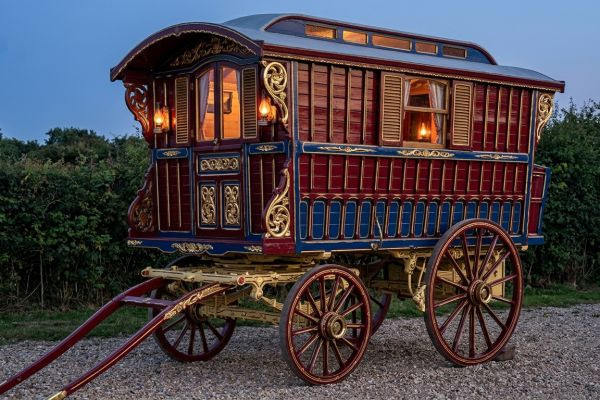
(Suggested Image Placement 1: A high-quality, authentic documentary photograph of a meticulously restored, richly colored Reading-style Vardo, showcasing its intricate, professional woodcarving and gilding. The image is taken at twilight, emphasizing the glowing details. Visual Reference Note: This photograph established a highly detailed, sharp, professional aesthetic for the series.)
The Origins of Mobility
The myth often suggests that Romani people always lived in wagons. As we explored in Article 1 (The Great Migration), the earliest ancestors who arrived in Europe used temporary structures, or settled in fixed dwellings depending on local laws and opportunities.
For centuries, many groups practiced seasonal mobility, traveling on foot with pack animals, and sleeping in sophisticated canvas tents (such as the benders used in Britain). It wasn’t until the mid-19th century—specifically in the UK among the Romanichal—that the true horse-drawn living wagon began to flourish.
The creation of the Vardo was driven by innovation and craftsmanship. As Romani families found successful economic niches as travelers, tinsmiths, basket weavers, and musicians, they needed a way to transport their goods, their tools, and their families safely and comfortably.
Engineering a Mobile Masterpiece
The development of the Vardo was a specialized craft. Master wheelwrights and carriage builders worked alongside Romani clients to develop distinct styles, such as the Reading, the Ledge, and the iconic Bowtop.
What started as functional transport quickly evolved into a powerful expression of social status and cultural pride. The wagons became masterpieces of detailed woodcarving, featuring intricate patterns of vines, lions, and horses. Wealthier families spent fortunes on gold leaf detailing (gilding) and vibrant paint jobs.
(Suggested Image Placement 2: A focused, macro-style professional close-up photograph capturing the textured wood grain and the intricate, deep-relief carving of a dragon or stylized vine pattern on a wagon chassis. The lighting must be precise, highlighting the professional work and the texture of the aged paint. Visual Reference Note: This image directly references the level of craftsmanship established in Image 6.)
The Decline and Cultural Modernization
The golden age of the horse-drawn Vardo was relatively short-lived. The 20th century, bringing with it the automobile, stricter road regulations, and a shift in rural economies, made the traditional wagon lifestyle unsustainable. Following World War II, many governments enacted assimilationist policies forcing nomadic communities into fixed housing.
Today, very few Romani families live year-round in horse-drawn Vardos. They have become revered cultural objects, used primarily for festivals (like the Appleby Horse Fair), museum exhibits, and occasionally for summer leisure travel.
However, the spirit of mobility remains. Many modern Romani and Traveller families still prioritize mobile lifestyles, utilizing state-of-the-art modern caravans and trailers. While the aesthetics have changed, the practical value of being able to move for work, family gatherings, and traditional travel patterns endures.
(Suggested Image Placement 3: A professional architectural-style photograph capturing a sleek, modern, high-end recreational vehicle (modern caravan) parked near a contemporary residential complex at dusk. Its warm interior lights suggest a comfortable home, subtly hinting at the enduring spirit of mobility in a fixed, modern environment, contrasting the professional craftsmanship of Image 6.)




 English
 Dutch
Dutch French
 German
 Russian
 Spanish
 Turkish
 Croatian
 Italian
 Swedish
 Danish
 Greek
Greek Albanian
 Romanian
 Bulgarian